OSHA Forklift Training Requirements for Temporary Workers
The Staffing Agency’s Complete Forklift Training Guide for Full Compliance with OSHA’s Temporary Worker Initiative (TWI Bulletin No.7)
Table of Contents
Temporary Worker Forklift Training Introduction
If you’re a staffing agency placing forklift operators, you’re operating under a joint employer arrangement whether you realize it or not. That means when one of your placements gets hurt on a client’s forklift, OSHA doesn’t just investigate the host employer, they investigate you too.
The Oregon Court of Appeals reversed an administrative decision that vacated OR-OSHA citations against staffing agencies, confirming they can still be treated as ‘employers’ under Oregon’s safety law even when they don’t control the host worksite.
The agencies in that case argued they shouldn’t be held responsible because they had no control over the client’s facility. The court rejected that argument completely. The ruling was clear: if you supply the worker, you’re an employer with specific legal duties, including training duties, that you cannot delegate through contract language.
The Question Staffing Agencies Get Wrong
When you place a forklift operator at a client’s worksite, who’s responsible for making sure they’re properly trained?
Many agencies assume the host employer handles it. The client owns the equipment, controls the workplace, and supervises the operator throughout the shift. Training would logically be their responsibility.
That assumption is leaving agencies exposed to OSHA citations and, just as damaging, preventing them from winning contracts with safety-conscious clients who are asking harder questions about training documentation before accepting placements.
The Problem Most Agencies Don’t See
You’re facing a compliance requirement built on a division of responsibility that most agencies, and many employers, fundamentally misunderstand.
There are specific training components you must provide as the staffing agency. There are other components only the host employer must provide. Getting this division wrong doesn’t just create regulatory exposure, it creates operational friction with clients and puts your placements at genuine risk.
The staffing firms that understand this structure are turning it into a competitive advantage. They’re positioning themselves as premium vendors who deliver “floor-ready” operators rather than commodity labor. They’re winning higher-value contracts because they’re solving a compliance problem for employers that most agencies are contributing to.
What This Guide Delivers
This guide explains exactly what OSHA requires, why the joint employer framework puts you at risk, and how to implement a training system that not only protects you from liability but actually gives you a competitive advantage in winning new business.
You’ll learn:
- The specific training components you’re responsible for and which ones the host employer must handle.
- The documentation and verification requirements that most agencies are completely missing.
- The real financial, operational, and reputational costs of non-compliance, backed by recent case studies.
- How pre-trained placements become a sales tool that lets you charge premium rates and win contracts from competitors.
- A practical implementation framework you can deploy regardless of whether you’re a single-branch agency or a national operation.
By the end of this guide, you’ll understand not just what OSHA requires, but why forward-thinking staffing agencies are treating forklift training as a business development investment rather than a compliance burden.
The agencies that get this right aren’t just avoiding fines, they’re becoming preferred vendors for the highest-paying clients in their markets. The agencies that ignore it are one incident away from a citation that goes on their permanent record and follows them to every safety-conscious client they pitch.
Let’s start with the foundation: what OSHA actually requires for forklift operator certification.
Understanding OSHA’s Forklift Training Requirements
OSHA’s Powered Industrial Truck Standard requires that operators, whether they’re direct employees or temp workers, complete two separate phases of training. These phases include:
General Training
This part of the training covers forklift fundamentals, safety, and theory. It’s basically the “classroom” portion of the training.
Workplace-Specific Training
This part of the training is completed in the workplace, using the actual equipment the operator will be working with. It covers workplace and equipment specifics.
Both training phases must also conclude with an evaluation. Phase 1 concludes with a knowledge assessment, and phase 2 concludes with a practical evaluation.
So here’s what the entire OSHA forklift certification process looks like for operators:
- General Forklift Training: This can be completed in a traditional classroom setting or via online training..
- Knowledge Evaluation: This can be completed by administering a test in a classroom setting or automatically when using online training.
- Workplace/Equipment-Specific Training: This type of training, also known as “on-the-job” training, is completed in the workplace using the specific equipment the operator will be working with.
- Practical Evaluation: A forklift trainer or evaluator will observe the operator performing forklift functions, confirm that they are performed safely and correctly, and then log those results on a checklist.
All four components are essential, and skipping any can be detrimental as it does not meet regulatory requirements, and worse, it could result in your workers getting injured or killed.
Training Language and Comprehension
OSHA requires that forklift training be provided in a language that employees can understand. This means employers must ensure that employees fully comprehend the training, not just that training was “provided.”
For temporary workers from staffing agencies, this requirement applies equally. For example, if your temporary workforce includes Spanish-speaking workers, you must provide Spanish forklift training.
Simply providing English-language training to workers who don’t understand English does not satisfy OSHA’s training requirements, even if those workers sign an attendance sheet or receive a certificate.
The Division of Responsibility
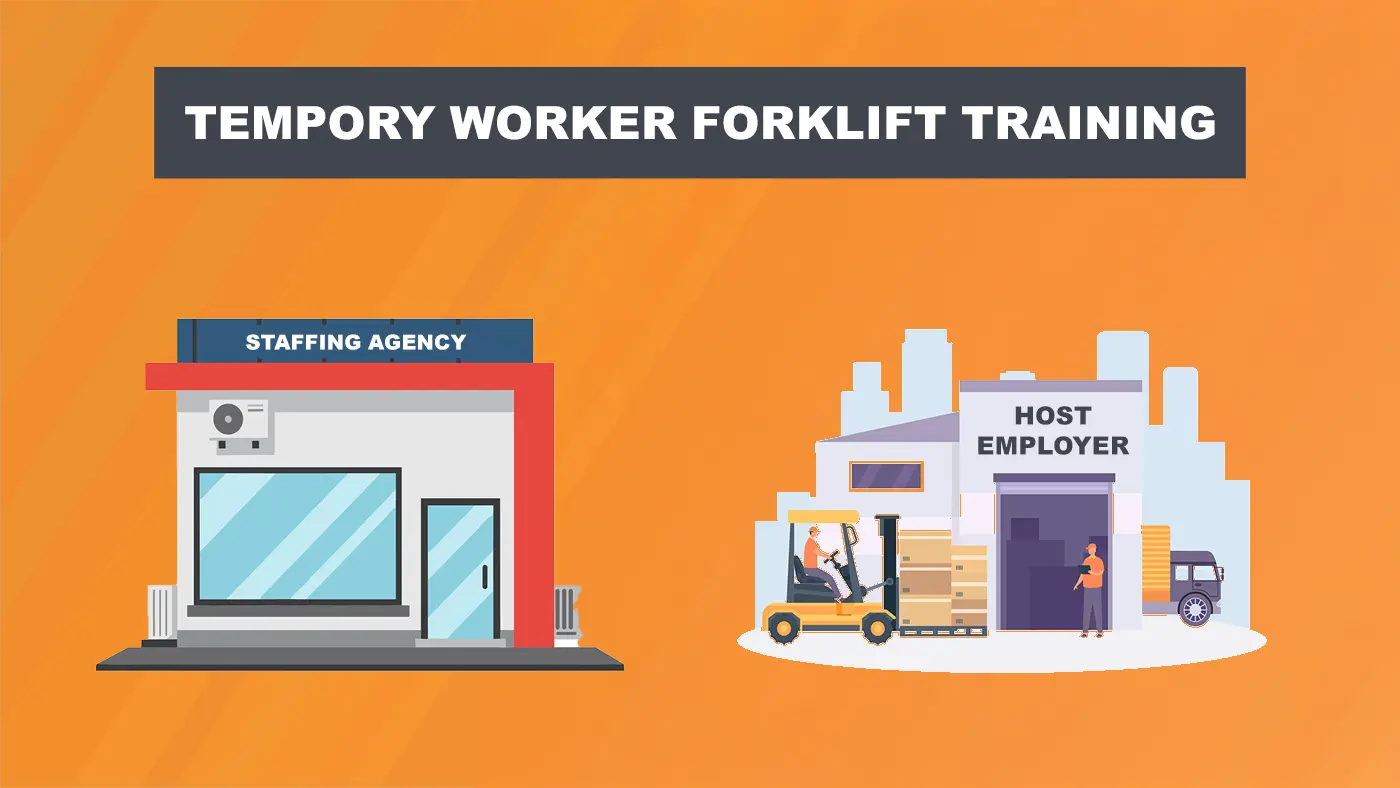
The four-component framework creates a natural division point in temporary worker placements. Some components can only be completed by the host employer, since they control the workplace and equipment. Other components can be completed before the worker ever arrives at the host employer’s facility.
Understanding which components belong to the staffing agency and which belong to the host employer is the foundation of OSHA’s Temporary Worker Initiative, which we’ll examine next.
OSHA’s Temporary Worker Initiative
OSHA developed the Temporary Worker Initiative (TWI) specifically to address compliance with safety and health requirements when temporary workers are employed under joint employment arrangements. The initiative recognizes that when a staffing agency supplies workers to a host employer, both entities function as employers with distinct but overlapping responsibilities.
TWI Bulletin No. 7 specifically covers powered industrial truck training. The bulletin establishes the framework for how forklift training responsibilities are divided between staffing agencies and host employers, clarifying which entity is responsible for each component of the forklift operator certification process.
Staffing Agency Forklift Training Responsibilities
According to TWI Bulletin No. 7, staffing agencies are generally responsible for providing placements with general forklift training that includes:
- General Training: Forklift fundamentals, theory, and general safety principles.
- Assessment: A knowledge evaluation to confirm the placement’s understanding of the materials.
This responsibility makes sense since the staffing agencies have the ability and control to provide this component of the training through various methods. And since they place workers across multiple client facilities with varying equipment types and workplace configurations, the general training provides a consistent baseline of knowledge that prepares workers to operate safely in any environment.
This general forklift training and evaluation can be completed through classroom instruction or online forklift training platforms without needing access to the host employer’s specific equipment or facility.
Staffing agencies cannot avoid this responsibility, even through contract language. Even if the placement agreement states that the host employer will handle all training, OSHA considers the agency independently responsible for ensuring general training occurs. Contracts can clarify operational procedures between the two parties, but they cannot transfer legal obligations.
Host Employer Forklift Training Responsibilities
The host employer is responsible for the workplace-specific training components that can only occur using the actual equipment in the actual work environment.
This means the host employer handles:
- Workplace-Specific Training: The on-site instruction covering the specific forklift models present at the facility, the unique hazards of that workplace, and any site-specific operational procedures or safety guidelines the employer has established.
- Practical Evaluation: The direct observation and assessment of the operator performing forklift tasks in the workplace, using the facility’s equipment. A qualified evaluator confirms and documents that the operator can safely perform the required operations.
This segmentation of responsibilities is obvious and even natural, because:
- Staffing agencies can provide general training applicable across multiple workplaces, but they don’t have access to the host employer’s specific equipment, facility, or knowledge of site-specific hazards needed for workplace-specific training.
- The host employer controls the workplace and equipment, making them the only party capable of providing workplace-specific training and practical evaluations.
Documentation and Verification
OSHA requires that both the staffing agency and host employers maintain documented evidence that forklift training occurred, usually in the form of a forklift certification. When OSHA conducts an audit or an incident triggers an inspection, training records are among the first items OSHA requests.
If either party cannot produce documentation proving that training was completed, OSHA will view it as the training never happened.
Verification of Training
Beyond maintaining their own records, both parties must verify that the other party is fulfilling their responsibilities.
Staffing agencies must take reasonable steps to confirm that host employers are providing workplace-specific training and evaluations. This means asking about their training process, confirming they have qualified evaluators, and requesting documentation that evaluations were completed.
Host employers must confirm that incoming temporary workers have received general training before allowing them to operate equipment. This means requesting proof of training completion before the worker starts and maintaining copies of those records.
The Real Costs of Non-Compliance
When temporary workers are placed into forklift operations without adequate forklift training, the consequences can be severe. The costs extend far beyond OSHA fines and can include lost contracts, damaged reputation, the inability to compete for high-value clients, and worst of all, injuries and fatalities.
Worker Injuries and Fatalities
Forklift incidents cause approximately 85 fatalities and 34,900 serious injuries annually in the United States. When a temporary worker lacks proper forklift training, they don’t understand fundamental safety principles like stability, load capacity limits, or how to recognize hazards. These knowledge gaps lead to tip-overs, struck-by incidents, and crushing injuries.
When a worker is seriously injured or killed, they leave behind a family – a spouse, children, parents who depended on them. That worker trusted their employers to prepare them properly for the job.
Also, when injuries or fatalities occur at client facilities, word spreads quickly. High quality workers and experienced operators avoid agencies with poor reputations and known safety issues. This shrinks the available talent pool and makes it harder to attract quality candidates.
In addition to the human loss, there can also be immediate business consequences.
OSHA Penalties and Citations
OSHA citations for training violations carry serious penalties (current to 2026):
- Serious violations: Up to $16,131 per instance
- Repeat violations: Up to $161,323 per violation
- Willful violations: Up to $161,323 per violation
For staffing agencies placing workers across multiple client facilities, a single training-related incident can trigger citations at multiple locations if OSHA finds a pattern of inadequate training practices.
OSHA regularly cites both parties in joint employment situations.
For example, following a worker fatality at Taylor Farms’ New Jersey facility in 2024, OSHA cited Taylor Farms for 16 violations totaling over $1.1 million in penalties. The staffing agency that supplied the worker, PL Solutions Group (operating as People Logistics), was separately cited for three serious violations with $33,100 in proposed penalties for failing to provide general training to the placements.
Both the host employer and the staffing agency were held accountable for the training failure that contributed to the fatality. The staffing agency couldn’t avoid citations by pointing to the host employer’s control of the worksite.
Insurance and Legal Costs
Workers’ compensation premiums increase following incidents involving temporary workers. Even when the incident occurs at the host employer’s facility, the staffing agency’s insurance rates are affected. These premium increases persist for years, directly impacting profit margins on every placement.
Legal defense costs add another layer of expense. Defending against OSHA citations typically costs $60,000 or more in legal fees, even when the agency ultimately prevails. In cases involving serious injuries or fatalities, these costs escalate significantly.
Civil litigation creates additional financial exposure.
When a temporary worker is injured, the host employer and staffing agency often turn on each other, each attempting to shift liability. The host employer claims the staffing agency failed to provide adequate general training. The staffing agency claims the host employer failed to provide proper site-specific training and supervision.
These disputes result in costly legal battles where both parties spend hundreds of thousands of dollars in legal fees arguing over who’s responsible – even when both parties share joint liability under OSHA’s framework.
The worker or their family may also file civil suits against both employers, further multiplying legal expenses.
Loss of High-Quality Clients
High-quality clients with strong safety programs increasingly require proof of safety training, including forklift training, before accepting placements. These clients have learned that untrained temporary workers create operational disruption, regulatory exposure, and incident risk.
When training documentation doesn’t exist, agencies can be immediately disqualified from these premium contracts. The clients that remain tend to be lower-tier operations with weaker safety cultures, and smaller budgets.
This creates a downward spiral: Without processes to upskill placements and provide general training per OSHA’s TWI, agencies can lose access to the best clients, forcing them to compete on price in the commodity labor market.
Public Record Damage
OSHA violations and civil cases become part of the public record. When safety-conscious employers conduct due diligence on potential staffing partners, they search OSHA’s citation database. Previous OSHA violations signal that basic compliance requirements aren’t being met.
The damage extends beyond the specific citation. Reputations develop around which agencies provide qualified operators and which agencies create problems. This information spreads through plant managers, safety directors, and procurement teams.
The Growing Competitive Gap
While agencies without training systems face mounting costs and shrinking client options, agencies that provide forklift training to their placements are positioning themselves as premium vendors.
These agencies can demonstrate immediate value to host employers: their placements arrive having completed the time-consuming classroom portion of forklift certification, allowing the host to complete site-specific training and evaluation in an hour or two instead of a full day.
As more employers recognize the value of pre-trained operators, the competitive gap continues to widen.
Competitive Advantage of Training Placements
Most staffing agencies either assume forklift training for their placements is entirely the client’s responsibility, or they treat it as a compliance cost that offers no real upside and slows down placements.
The agencies that outperform their competitors treat it differently. They use forklift training as a sales and retention tool: by training and upskilling their placements, they make them more attractive to clients, easier to approve, faster to start, and more likely to convert to full-time employees.
Time Savings that Turn into Quicker Starts
The theory (classroom) portion of forklift certification is the most time-consuming and disruptive piece of the process. Someone has to schedule classroom time, pull workers off the floor for 4–8 hours, line up a trainer, and deal with no‑shows and rescheduling.
When your placements arrive with general forklift training already done, the client can go straight to the workplace‑specific training and practical evaluation. In most operations, that cuts onboarding from nearly a full day or more down to a couple of hours.
For the client, that’s a huge amount of value. For your agency, it means fewer pushed start dates, fewer “we’ll bring them in next week” stalls, and more orders that actually turn into billable hours.
Higher Conversions with Better Clients
Safety‑conscious employers are increasingly asking for proof of forklift training before a temporary worker arrives onsite, and some now bake that requirement into contracts and vendor screens.
When you provide your placements with forklift training and they receive a certificate, you clear that hurdle without debate. You’re no longer competing against every low‑cost vendor in the market; you’re competing against the much smaller group that can prove they send trained, documented operators.
That shows up as higher win rates with better accounts: larger volumes, stronger safety programs, and clients that are thinking in terms of ongoing partners, not one‑off spot buys.
Preferred Vendor Instead of “Warm Bodies”
Untrained placements feel like work. Supervisors have to slow down, explain basics, watch closely, correct avoidable mistakes, and hope nothing serious happens while the operator catches up. After a few of those experiences, your agency gets mentally filed under “warm bodies.”
Trained placements change that experience. Your operators arrive with a consistent baseline in fundamentals, stability, load handling, and general safety rules, so the client can spend their 1–2 hours on equipment specifics, workplace-hazards, and the practical evaluation.
Over time, that difference is what moves you into preferred‑vendor territory. You become the agency that “just sends people who are ready,” which makes you harder to replace and gives you more leverage when rates and terms come up.
Fewer Failed Placements and Higher Margins
When a forklift placement flames out in the first week, the client rarely says “training was the issue.” They say “this is a bad fit” and ask for a replacement. You eat the scramble, the extra recruiting, and the lost hours on that order.
A lot of those failures come down to the same core problem: the operator never had the baseline knowledge to run equipment safely and confidently, so they needed too much coaching and correction.
By sending operators who already completed forklift training, you take that variable off the table. You get fewer early terminations, fewer urgent replacements, and stronger margins on the work you’ve already sold.
A Stronger Liability Position
In temporary placements, you have employer responsibilities without owning the facility or the equipment. Under the joint‑employer framework, you’re expected to handle general training and, while the host employer handles workplace‑specific training and practical evaluations.
Training placements in advance doesn’t solve everything the client has to do, but it does mean you can prove you consistently handled the part that sits on your side of the line. When there’s an incident, you’re not hoping the client’s paperwork covers you. You have your own documented training tied to that worker.
That puts you in a better position with regulators, insurers, and safety‑focused buyers. It turns training from a fuzzy “we think they covered it” into a clear, defensible part of your process.
Getting Ahead of Your Competitors
As more employers become familiar with OSHA’s temporary worker initiative, they expect that temporary forklift operators arrive with general forklift training already completed. Some already require it and are baking it into the agreements, contracts, and procurement procedures
As this trend continues to build momentum, agencies that provide forklift training to their placements now will be the winners. They become the vendors employers prefer to work with, they protect their margins, and they lock in preferred‑vendor status while pre‑trained operators still differentiate them.
Agencies that wait will still have to get their workers trained. The difference is they’ll be doing it after their clients start demanding it, at lower rates, and against competitors who are already known for sending safe, floor‑ready operators as standard.
Forklift Training Options for Staffing Agencies
By now, you know that as a staffing agency, you’re required to provide general forklift training to your placements. Luckily, there are several options available to choose from. Here are the most common options:
External Training Providers
Agencies can send placements to third-party training centers for classroom instruction, or bring external trainers to their facility.
External providers handle curriculum development and delivery, but this approach introduces coordination complexity and higher per-person costs.
Considerations
- Workers must travel to training locations or wait for scheduled sessions.
- Training costs typically range from $150-300 per person.
- Scheduling delays can push back placement start dates.
This option can work for agencies placing operators occasionally, but becomes expensive and inefficient at scale. Especially if you are also paying for the placements training and travel time.
For example, live training can take at least a day in some cases. So if you’re paying for the placements travel at 1 hour each way, you could be paying 10 hours of wages on top of the $150 to $300 for the training.
In-House Instructor-Led Training
Some agencies develop internal training programs where qualified staff deliver classroom instruction at agency locations or branches.
This approach gives agencies direct control over training content and scheduling. However, it requires dedicated space, qualified trainers at each location, and the ability to coordinate sessions around placement timing.
Considerations
- Requires trainers who meet OSHA’s “qualified person” requirements.
- Training schedules must align with placement starts across multiple locations.
- Workers need to be physically present, which limits flexibility.
- Consistency becomes difficult when multiple trainers deliver the same content.
- Documentation and record-keeping must be managed manually.
For single-location agencies with high forklift placement volume, this can work. For multi-location agencies or those with variable placement timing, it creates significant logistical challenges.
One of the biggest cons of this approach is training efficiency.
For example, if you’re training one placement at a time, your trainer could be spending up to four hours in that session. If you calculate your trainers hourly rate using their salary, and then divide it by four, that is the additional cost to train that placements.
If your internal trainer’s hourly rate is $30/hour and the placements rate is $20/per hour, then the total training cost is $200 for just one placement. This doesn’t even factor in the time away from your trainers other regular duties.
Online Forklift Training
Online training delivers the general forklift training component through a web-based platform that workers can access from any location at any time.
Workers complete the classroom instruction covering forklift fundamentals, stability principles, load handling, hazard recognition, and safety requirements. The platform administers the knowledge evaluation and generates documentation automatically.
Considerations
- Placements complete training when most convenient, before arriving at the client site.
- Online training is faster than traditional methods and typically takes only 2 – 3 hours.
- Training is identical for every placement regardless of which branch enrolls the worker.
- No need to coordinate physical locations, schedules, or trainer availability.
- Documentation and certificates are generated and stored automatically.
- Cost per placement is significantly lower than instructor-led alternatives.
- Training can scale from one placement to thousands without additional infrastructure.
This approach aligns naturally with how staffing agencies operate: multiple locations, variable placement timing, and the need for consistent documentation across all workers.
The Natural Fit for Staffing Agency Operations
The structure of OSHA’s training requirements for temporary workers creates a natural blended forklift operator training model, but it’s split between two employers rather than two training methods.
The staffing agency provides the theory foundation through general training. The host employer applies that foundation through workplace-specific training and practical evaluation.
Online training fits this framework precisely. The agency ensures every placement completes the same OSHA-aligned general forklift training before arrival at any client site. The host employer then focuses exclusively on their specific equipment, facility hazards, and operational procedures.
This creates clean documentation on both sides. The agency has records proving they provided general training. The host employer has records showing they completed site-specific training and evaluation.
For agencies placing operators across multiple client facilities with different equipment types and configurations, this consistency matters. The same general training applies whether the placement goes to a warehouse in Chicago or a distribution center in Atlanta. The host employer builds on the same foundation regardless of which worker the agency sends.
Choosing the Right Forklift Online Training Partner
Not all online forklift training providers are built for staffing agencies. When evaluating options, focus on the features and capabilities that directly impact your ability to scale training, maintain documentation, and meet OSHA’s requirements efficiently.
OSHA Alignment and Compliance
The training must align with OSHA 1910.178 standards to satisfy the general training requirement under TWI Bulletin No. 7.
Look for providers that clearly state their regulatory alignment and update content when standards change. The course should cover all required topics: forklift fundamentals, stability principles, load handling, hazard recognition, and safety requirements.
Generic “1-hour forklift certification” courses don’t meet OSHA’s formal instruction requirement. The content needs to be comprehensive enough that host employers can confidently build their workplace-specific training on that foundation.
Pricing Structure and Volume Discounts
Your placement volume determines what pricing model makes sense. Agencies placing dozens, hundreds, or thousands of forklift operators annually need volume pricing that scales without creating budget uncertainty.
Considerations
- Does the provider offer bulk pricing or tiered discounts?
- Do purchased registrations expire, or can you buy ahead for future placements?
- Are there hidden fees for certificates, record access, or account management?
Expiring registrations force you to either lose money on unused training or scramble to use credits before they disappear. Non-expiring registrations give you flexibility to buy at volume pricing and use them as needed.
Course Quality and Engagement
Not all online forklift training courses are created equal. Text-only, courses that feel like reading a manual lead to poor retention and workers who complete the course without actually learning.
Look for training that includes:
- Modern and engaging components such as videos and knowledge checks.
- Interactive elements that require active participation.
- Real-world scenarios that show how concepts apply in real life.
- Visual explanations of complex topics like stability triangle and load capacity.
Higher-quality courses create better outcomes when workers arrive at the host employer.Supervisors can tell the difference between someone who completed a poor quality course vs someone who engaged with comprehensive instruction.
Multi-Location and Enrollment Flexibility
If you operate multiple branches or place workers across different regions, your training provider needs to support that structure.
Look for:
- Centralized account management across all locations.
- Flexible enrollment options (email-based, manual credential creation, bulk upload).
- Fast enrollment that doesn’t create delays when you need to place someone quickly.
The enrollment process should take minutes, not hours. If you need to send someone to a client tomorrow, you can’t wait for manual account setup or administrative approvals.
Documentation and Record-Keeping
Automated documentation is essential for staffing agencies. You need instant access to certificates when host employers request them, and you need organized records if OSHA ever asks for training verification.
Key features you need:
- Automatic certificate generation upon course completion.
- Easy access to all training records in your account.
- Ability to download certificates immediately.
- Searchable reports of completed training by worker name or date.
- Retention of records even after placements leave your agency.
Manual record-keeping creates gaps. Digital systems that automatically track and store everything eliminate the risk of missing documentation during audits or client verification requests.
Platform Usability and Reliability
The forklift training platform should be intuitive enough that placements can complete it without constant hand-holding, and stable enough that technical issues don’t delay starts.
Check for:
- Mobile compatibility (can workers complete training from phones/tablets?).
- Clear course navigation and progress tracking.
- Automatic save functionality so workers don’t lose progress.
- Minimal technical requirements (modern browser access, no special plugins).
- Platform uptime and reliability track record.
If workers struggle with the platform or encounter frequent technical problems, you’ll spend more time troubleshooting than training.
How to Train Your Temporary Workers
Meeting your obligations under OSHA’s Temporary Worker Initiative using ForkliftTraining.com is straightforward and can be completed in just a few steps.
Step 1: Purchase Training Registrations
Purchase online forklift training registrations for each temporary worker you’ll be training. With ForkliftTraining.com registrations never expire. This allows you to buy in bulk to take advantage of volume discounts while keeping registrations available in your account until you’re ready to use them.
Step 2: Enroll Your Placements in the Training
Enroll your placements in the training using your preferred enrollment options. You can enroll them with their name and email address and they’ll receive an email with instructions on how to start. You can also enroll them without email by creating a username and password for them.
Step 3: Placement Completes the Training
The placement completes the online forklift training course when it’s most convenient. Once they complete the course, they will be awarded a certificate of completion that they can provide to the host employer when they arrive on site. The certificate of completion is also available in your account, so all of your record-keeping is automated.
You can learn more about our complete Forklift Training Compliance System for Temp Workers and Placements here: [Forklift Training for Staffing Agencies]
Frequently Asked Questions
Who’s responsible for forklift training for temporary workers?
Both the staffing agency and the host employer share responsibility to provide forklift training to temporary workers under OSHA’s joint employer model.
The staffing agency provides general forklift training, while the host employer provides site-specific training on their equipment, procedures, and hazards, as well as conduct the practical evaluation.
Do staffing agencies have to provide forklift training?
Yes. Under OSHA’s Temporary Worker Initiative (TWI Bulletin No. 7), staffing agencies must provide general forklift training and knowledge evaluation to temporary workers before placing them in forklift operations.
How much does forklift training cost for staffing agencies?
Online forklift training typically costs between $59 – $99 per worker with volume discounts available.
Traditional instructor-led training at a live training center can range from $150-300 per person plus wages for travel and training time.
In-house training requires qualified trainers and dedicated time, often costing $200+ per placement when factoring trainer and worker wages.
What forklift training must be completed before a temp worker operates a forklift?
Temporary workers must complete the same forklift training required of any worker who operates a forklift under OSHA’s requirements. The main difference with temp workers is that the staffing agency typically completes the general forklift training while the host employer completes the workplace-specific training and a practical evaluation.
Is online forklift training OSHA-compliant for temporary workers?
Yes. OSHA allows general forklift training to be completed online as long as required topics are covered and a knowledge evaluation is included.
What is OSHA’s Temporary Worker Initiative (TWI Bulletin NO.7) for Powered Industrial Truck Training?
TWI Bulletin No. 7 establishes how forklift training responsibilities are divided when staffing agencies and host employers share joint employment of temporary workers.
Generally, staffing agencies provide general forklift training covering fundamentals and safety principles. Host employers provide site-specific training on their equipment and workplace hazards, plus conduct practical evaluations.
The bulletin further states that neither employer may avoid its responsibilities under the OSH Act by requiring another party to perform them.