OSHA’s Top 10 Citations for 2026: 5 Forklift Requirements to Check Today
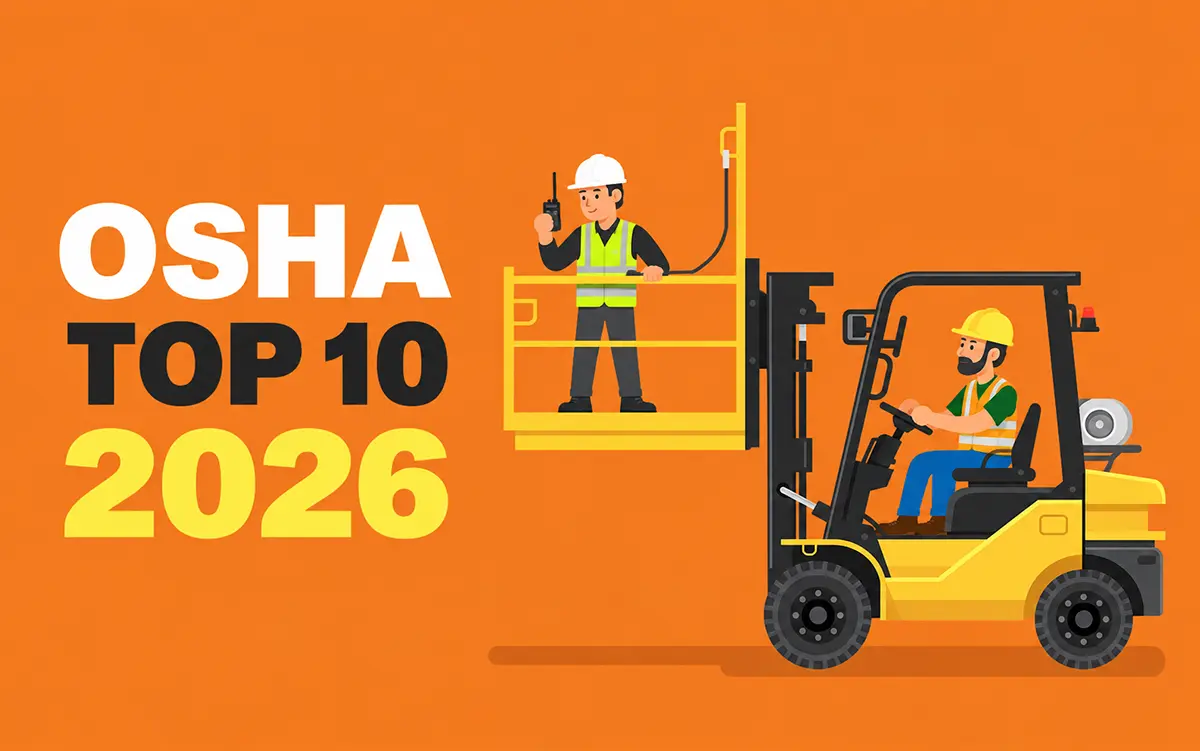
Every year, OSHA releases a list of the workplace safety standards it cites most often during inspections. In the preliminary results for fiscal year 2026, powered industrial trucks, including forklifts, rank seventh, with 1,379 violations.
If you manage forklift operators, it’s important to understand what’s behind that number. Are your operators properly trained? Are their evaluations current? What happens when someone reports a forklift maintenance issue?
Below is the full Top 10, followed by specific forklift requirements and quick checks you can use to review your operation.
OSHA’s Top 10 for 2026 (Preliminary)
OSHA announced these results at the NSC Safety Congress & Expo on September 15, 2026. The figures are preliminary, meaning counts and rankings may change when the final data are published.
| Rank | Standard | Standard number | Preliminary violations |
|---|---|---|---|
| 1 | Fall Protection – General Requirements | 1926.501 | 4,041 |
| 2 | Hazard Communication | 1910.1200 | 1,961 |
| 3 | Lockout/Tagout | 1910.147 | 1,863 |
| 4 | Scaffolding | 1926.451 | 1,725 |
| 5 | Ladders | 1926.1053 | 1,659 |
| 6 | Respiratory Protection | 1910.134 | 1,608 |
| 7 | Powered Industrial Trucks (including forklifts) | 1910.178 | 1,379 |
| 8 | Fall Protection – Training Requirements | 1926.503 | 1,273 |
| 9 | Eye and Face Protection | 1926.102 | 1,120 |
| 10 | Machine Guarding | 1910.212 | 1,072 |
Source: National Safety Council’s preliminary FY 2026 announcement. Hazard Communication is listed here using the correct OSHA standard number, 1910.1200.
Which Forklift Requirements Should You Check?
The 1,379 violations cover OSHA’s powered industrial truck standard, 1910.178, as a whole. The preliminary announcement does not provide counts for its individual subsections. The sections below explain specific requirements to review, rather than a ranked breakdown of the 2026 citations.
1. Operator Training and Competence — 1910.178(l)(1) and (l)(2)
Employers must ensure operators are competent to operate forklifts safely. Proper training includes formal instruction (online or classroom training), workplace-specific training, and a practical evaluation before an operator works independently.
What to check: Pick a few operators and confirm that theory training, workplace-specific training, and practical evaluations have all been completed and are applicable to their specific jobs and equipment.
Our blended forklift training guide explains how online instruction fits together with practical training and evaluation at your workplace.
2. Refresher Training and Evaluations — 1910.178(l)(4)
OSHA requires refresher training in relevant topics after unsafe operation, an accident or near miss, an evaluation showing unsafe performance, assignment to a different type of truck, or a workplace change affecting safe operation.
What to check: Compare recent incident reports and changes in truck assignments or working conditions with your training records. Was the relevant refresher training completed? Check the last performance evaluation date for each operator.
The North American forklift safety consensus standards (ANSI B56.1 and CSA B335) require complete refresher training at least every three years. This is the industry benchmark for forklift training programs. If your company goes beyond the minimum standard, you should confirm that your operators have received training within the last 3 years.
3. Certification Records — 1910.178(l)(6)
As an employer, you must ensure that each operator has been trained and evaluated and maintain records for all training activities.
What to check: When reviewing training records, ensure they are easily accessible and display the required information including the operator’s name, date of training and evaluation, and the name of the trainer/evaluator.
4. Equipment Inspections — 1910.178(q)(7)
Forklifts must be inspected before service, at least daily. Trucks used around the clock must be examined after each shift, and any defects must be reported and corrected.
What to check: A simple check is to observe operators performing their pre-use inspections and have them explain how they report a defect. You can also follow one or more reported problem(s) through to the repair. OSHA’s pre-operation guidance describes visual and operational checks in more detail.
5. Removing Unsafe Equipment from Service — 1910.178(p)(1)
A defective or unsafe truck must stay out of service until it has been restored to safe operating condition.
What to check: If an operator reports a brake problem today, how would your team stop the next shift from using that truck? Confirm who takes it out of service and who verifies it is safe before it returns to use.
Training Language and Comprehension
It’s important to understand that OSHA also requires that forklift training be provided in a language and vocabulary that employees can understand. This means employers must ensure that employees fully comprehend the training content.
If you’re training Spanish-speaking operators, ensure that you’re providing them with Spanish forklift training since providing English-language training to workers who don’t speak English does not meet OSHA’s requirements.
What a Forklift Incident Can Reveal
In June 2024, a forklift operator suffered fatal injuries at Mitchell Industrial Tire’s distribution center in Elm Mott, Texas, after a rack system failed and a pallet of industrial truck tires fell.
OSHA’s investigation found damaged rack supports, missing beam locks, improper pallet storage, and inadequate forklift driver training. The company received 12 citations and faced $288,299 in proposed penalties.
At your site, would an operator know how to report damaged racking or another hazard? Who would keep people away from the hazard and make sure it was corrected?
If You Find a Training Issue
Start with the part that is missing. An operator may need formal instruction, workplace-specific training on a particular truck, an updated practical evaluation, or refresher training on a specific task.
Our online forklift operator training provides the required “classroom” training. Qualified trainers then deliver workplace-specific training and evaluate operators in the workplace. The blended training guide walks through how to organize those steps within your company.
If you need help preparing internal trainers, our forklift trainer and evaluator program covers instructional techniques and practical evaluation methods. Trainers and evaluators must have the knowledge, training, and experience needed to carry out that work.